
Over the past year, Microsoft has been one of the most closely watched technology stocks in the world. However, since peaking last fall, Microsoft shares have declined by more than 25%, raising serious concerns among investors. This sharp sell-off has been fueled by growing fears around artificial intelligence disruption, rising capital expenditures, and increasing dependence on key partnerships like OpenAI.
While the decline may appear alarming on the surface, it also raises an important question: is Microsoft stock now a risky investment, or does this correction represent a rare, once-in-a-decade buying opportunity?
Why Microsoft Stock Is Falling
The recent decline in Microsoft’s stock price is not due to a single factor but rather a combination of concerns that have unsettled investors.
One of the biggest issues is the fear that generative AI could disrupt Microsoft’s traditional enterprise software model. Analysts worry that advanced AI tools might reduce the reliance on expensive enterprise solutions like Microsoft 365, potentially weakening one of the company’s most profitable segments.
Additionally, Microsoft’s aggressive spending on AI infrastructure has raised eyebrows. The company significantly increased its capital expenditures, investing tens of billions of dollars into data centers and cloud infrastructure. However, this spending has not yet resulted in proportional revenue growth, particularly in its Azure cloud business.
Despite Azure maintaining strong growth rates of around 38% to 39%, investors expected even faster acceleration given the scale of investment. The mismatch between spending and revenue has created doubts about the efficiency of Microsoft’s AI strategy.
Key Risks Investors Should Consider
Investing in Microsoft today comes with several risks that cannot be ignored.
1. Azure Growth Concerns
Azure remains Microsoft’s most important growth driver, but recent results have disappointed expectations. While revenue growth is strong, it has not accelerated in line with increased investment. This has led to concerns that demand may not be keeping pace with supply.
Management has explained that part of the issue stems from allocating resources to internal AI development, which limits capacity available for external customers. However, this explanation has not fully reassured investors.
2. Slow Adoption of AI Products
Microsoft’s AI-powered Copilot has gained traction, but adoption remains relatively low compared to its massive user base. With around 15 million paid subscribers out of 450 million commercial users, penetration is still in its early stages.
This raises questions about how quickly Microsoft can monetize its AI investments and whether adoption will accelerate in the coming years.
3. Dependency on OpenAI
Microsoft’s partnership with OpenAI is both a strength and a risk. The company has committed heavily to this relationship, including a multi-year deal worth approximately $250 billion.
While this partnership positions Microsoft as a leader in AI, it also creates concentration risk. If OpenAI faces financial or operational challenges, it could significantly impact Microsoft’s growth strategy.
Why the Market May Be Overreacting
Despite these concerns, many analysts believe that the market may be overestimating the risks and undervaluing Microsoft’s long-term potential.
Microsoft remains one of the most dominant players in enterprise software, with a deeply entrenched ecosystem that includes Windows, Microsoft 365, Dynamics, and Azure. These products are critical to business operations worldwide, making it difficult for competitors to displace them.
The company’s strong market position provides a significant cushion against potential disruptions. Even if AI changes the software landscape, Microsoft is well-positioned to adapt and lead the transformation.
Microsoft’s Strength in AI and Cloud
Microsoft’s aggressive investment in AI should not be viewed solely as a risk—it is also a major opportunity.
The company is building one of the largest AI infrastructure networks in the world, positioning Azure as a leading platform for AI workloads. As businesses increasingly adopt AI technologies, demand for cloud computing is expected to rise significantly.
Microsoft’s hybrid approach—combining cloud services with enterprise software—gives it a unique advantage. It can integrate AI directly into its existing products, creating new revenue streams while strengthening its competitive moat.
The Role of the New E7 Bundle
One of the most important developments for Microsoft is the upcoming launch of its new E7 enterprise software package.
This bundle combines AI-powered tools like Copilot with core Microsoft applications, offering a comprehensive solution for businesses. Priced at $99 per user per month, the E7 package reflects Microsoft’s confidence in its pricing power and value proposition.
The introduction of E7 is expected to drive higher adoption of AI services, increasing revenue and improving the return on Microsoft’s AI investments.
Financial Strength and Valuation
From a financial perspective, Microsoft remains a highly profitable company with strong cash flow generation.
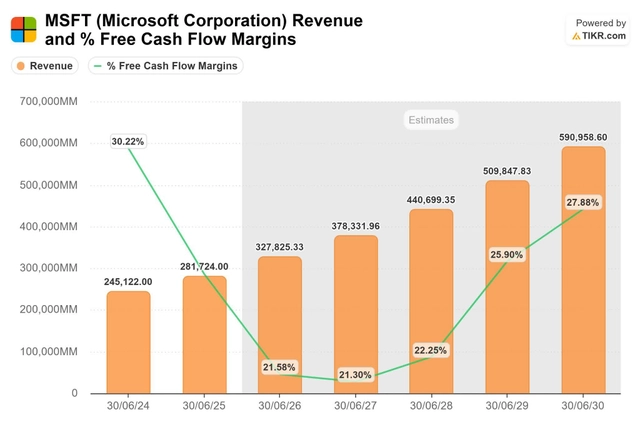
Despite increased spending, the company is expected to maintain free cash flow margins above 20%, demonstrating its ability to invest heavily while remaining financially stable.
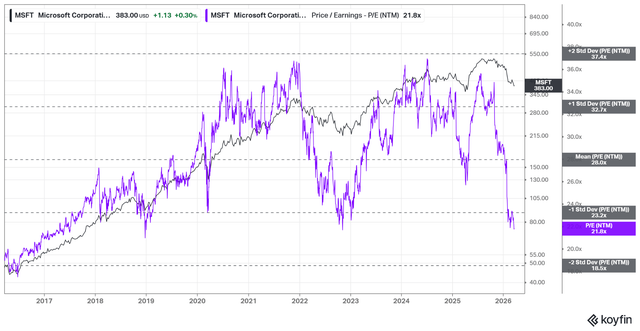
Another key factor is valuation. Microsoft’s forward earnings multiple has dropped significantly, bringing it closer to the level of the broader market. This is unusual for a company of its quality and growth potential.
Historically, such valuation levels have presented attractive entry points for long-term investors.
Is Microsoft Still a Strong Growth Story?
Even with short-term challenges, Microsoft’s long-term growth story remains intact.
Analysts expect the company’s earnings per share to grow by over 20% in the near term, followed by continued double-digit growth in subsequent years. This level of growth, combined with a strong competitive position, supports the case for long-term investment.
The integration of AI into Microsoft’s ecosystem is likely to drive future growth, particularly as businesses increasingly rely on automation, data analytics, and intelligent software solutions.
Buy or Avoid: What Should Investors Do?
The decision to invest in Microsoft ultimately depends on an investor’s time horizon and risk tolerance.
For short-term investors, the stock may remain volatile due to ongoing uncertainty around AI adoption and capital expenditures. Market sentiment could continue to shift as new data emerges.
However, for long-term investors, the current dip may represent a compelling opportunity. Microsoft’s strong fundamentals, market leadership, and AI strategy position it well for future growth.
While risks exist, they appear manageable given the company’s scale, resources, and track record of innovation.
Microsoft’s recent stock decline has sparked intense debate among investors. On one hand, concerns about AI disruption, rising costs, and dependency on key partnerships have created uncertainty. On the other hand, the company’s strong fundamentals, strategic investments, and market leadership suggest that it remains well-positioned for long-term success.
Rather than signaling a fundamental weakness, the current sell-off may simply reflect short-term market fears. For investors willing to look beyond immediate concerns, Microsoft could represent one of the most attractive opportunities in the technology sector today.
FAQ

Tata Motors CV Turns Volatile After Strong Listing
Tata Motors CV Share Listing LIVE: Tata Motors Commercial Vehicles shares were listed in the…

The Powerful Rise of Fintech Innovation
The financial world is undergoing its biggest transformation in decades, and the driving force behind…
Microsoft Stock: Buy Now or Big Risk Ahead?
Over the past year, Microsoft has been one of the most closely watched technology stocks…

Why Nature Travel Is the Best Way to Recharge and Reduce Stress
In today’s fast-paced world, stress has become a common part of daily life. Long working…

Child Care Funding Under Merkley Spotlight
Child care in the United States has now joined a growing list of industries where…

Ultimate Guide to Entertainment Trends in 2026
Entertainment in 2026 is more dynamic than ever before. With rapid advancements in technology and…