

What is a social media strategy?


A social media strategy is a documented plan that defines how your brand uses social platforms to achieve specific business objectives, from awareness and community building to lead generation and customer loyalty.
Social media strategy is the intersection of business goals, audience insight and channel selection. It answers three questions: WHO we want to reach, WHAT value we bring them, and HOW we measure whether it’s working.
Without a strategy, social media becomes reactive posting. With one, it becomes a system that produces measurable outcomes. The best strategies are short, specific and reviewed regularly, not 40-slide decks that no one opens.
A useful test: can any team member state your social media objective in one sentence, without checking a document? If yes, you have a strategy. If not, you have a content calendar dressed up as one.
A strategy is not a channel plan, and it is not a content calendar. It sits above both. The channel plan answers ‘where do we post?’ The content calendar answers ‘what do we post this week?’ The strategy answers ‘why are we doing any of this?’
Top Social Media Marketing Trends in 2026

1.Short-Form Video Continues to Dominate
Short-form videos on Instagram Reels, YouTube Shorts, and TikTok drive maximum reach and engagement.
Growth Strategy: Learn storytelling, hooks, and video SEO—skills taught in practical social media marketing courses at School of Digital Marketing.
2.AI-Powered Content Creation
AI tools are reshaping content planning, caption writing, video editing, and performance analysis.
Growth Strategy: Marketers trained in AI-based social media tools gain faster execution and higher ROI.
3.Social Commerce Becomes Mainstream
Buying directly through social platforms is becoming common.
Growth Strategy: Brands must optimize product catalogs, reels, and paid ads—skills covered in advanced social media marketing modules.
4.Authentic & Human-First Content
Audiences prefer real stories over polished ads.
Growth Strategy: Use UGC, behind-the-scenes content, and relatable brand storytelling.
🚀 Ready to master Social Media Marketing for 2026?
Join the School of Digital Marketing (SDM) and gain hands-on training with AI tools, live projects, and real campaign experience.
and future-proof your digital marketing career.
5.Micro-Influencer Marketing
Micro and nano influencers offer better trust and engagement.
Growth Strategy: Learn influencer outreach, campaign planning, and ROI tracking through real-world projects.
Building Your Modern Social media Blueprint
Let’s get one thing straight: the old “post and pray” method of social media is dead. If your game plan is to just throw content at the wall and hope something sticks, you’re not just wasting time—you’re falling behind. A modern, effective strategy is a focused blueprint that ties every single post, story, and comment directly to real business goals.
It’s no longer about just being on social media; it’s about being there with a clear purpose.
Forget the complicated jargon and abstract theories for a moment. Think of your strategy as the practical roadmap we’ll follow together, guiding you from setting your initial goals all the way to analyzing your performance and making smart adjustments.
The Core Pillars of a Winning Strategy
| Pillar | Objective | Key Action | Example Metric |
| Goals & Objectives | Align social media with business outcomes. | Define SMART goals (Specific, Measurable, Achievable, Relevant, Time-bound). | Increase website traffic from social by 15% in Q3. |
| Audience Definition | Understand who you’re talking to. | Create detailed audience personas based on data and research. | Audience engagement rate within your target demographic. |
| Channel Selection | Be where your audience is most active. | Research platform demographics and choose 2-3 primary channels. | Growth in followers/subscribers on chosen platforms. |
| Content Strategy | Provide value and build relationships. | Develop 3-5 content pillars that align with audience interests and brand voice. | Likes, comments, shares, and saves per post. |
| Execution & KPIs | Implement, measure, and optimize. | Create a content calendar, schedule posts, and track key performance indicators. | Conversion rate from social media leads. |
Mastering each of these pillars is what separates the brands that thrive on social media from those that just get lost in the noise.
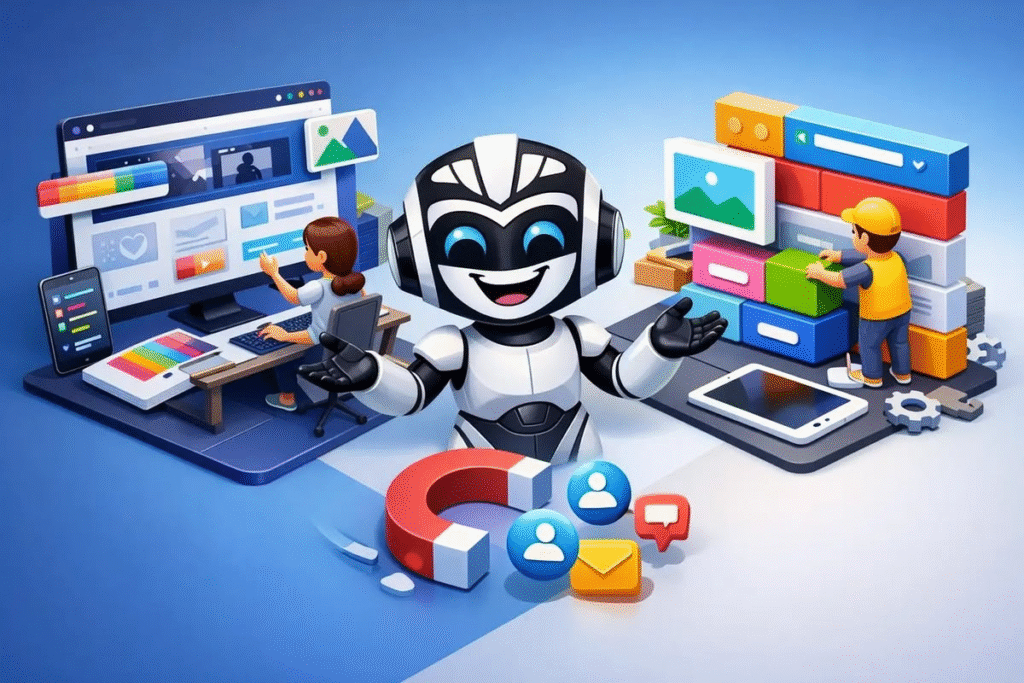
An effective social media strategy relies on adapted tools. Here are the essential categories and recommended solutions:
- Planning and scheduling: Buffer, Hootsuite, Later, or Metricool to schedule your posts in advance and manage multiple accounts from a single interface.
- Visual creation: Canva (templates and quick design), Adobe Express, or Figma for more advanced creations. AI tools like Google Stitch also allow for rapid prototyping of visuals.
- Video editing: CapCut (free and powerful for short-form formats), DaVinci Resolve, or Adobe Premiere Rush for more elaborate edits.
- Analytics and reporting: native tools (Meta Business Suite, TikTok Analytics, LinkedIn Analytics) supplemented by Sprout Social or Iconosquare for consolidated reports.
- Monitoring and social listening: Mention, Brand24, or Brandwatch to monitor what is being said about your brand and industry.
- AI and automation: ChatGPT, Jasper, or Copy.ai to accelerate caption writing and content idea generation.
The important thing is not to use all these tools, but to choose those that match your publishing volume and budget. A freelancer does not have the same needs as a marketing team of ten people.
For a broader view of digital transformation and the integration of AI into your strategy, consult our analysis on AI and e-commerce.
FAQS
1. What is a social media strategy?
A social media strategy is a planned approach for creating, publishing, and managing content to achieve specific business or personal goals.
2. How do I create a social media strategy in 2026?
Define your goals, understand your audience, choose the right platforms, create useful content, maintain a consistent schedule, and track performance.
3. Which social media platforms are most important in 2026?
Instagram, YouTube, TikTok, Facebook, LinkedIn, and X can be valuable depending on your audience, content type, and goals.
4. How often should I post on social media?
Post consistently according to your audience and platform rather than focusing only on a specific number of posts each week.
5. What type of content performs well on social media?
Short-form videos, educational content, behind-the-scenes posts, useful tips, storytelling, and engaging visual content can perform well.